
PortfolioOps Perspectives™
Executive thinking on portfolio leadership, governance, decision intelligence, and strategic execution.
Ideas shape organizations.
At PortfolioOps™, we believe executive portfolio leadership is about more than overseeing projects. It is about enabling better decisions, aligning investments to strategy, and improving organizational outcomes.
PortfolioOps Perspectives™ is our collection of original thought leadership exploring the ideas, operating models, and executive capabilities that help organizations move from strategy to outcomes.
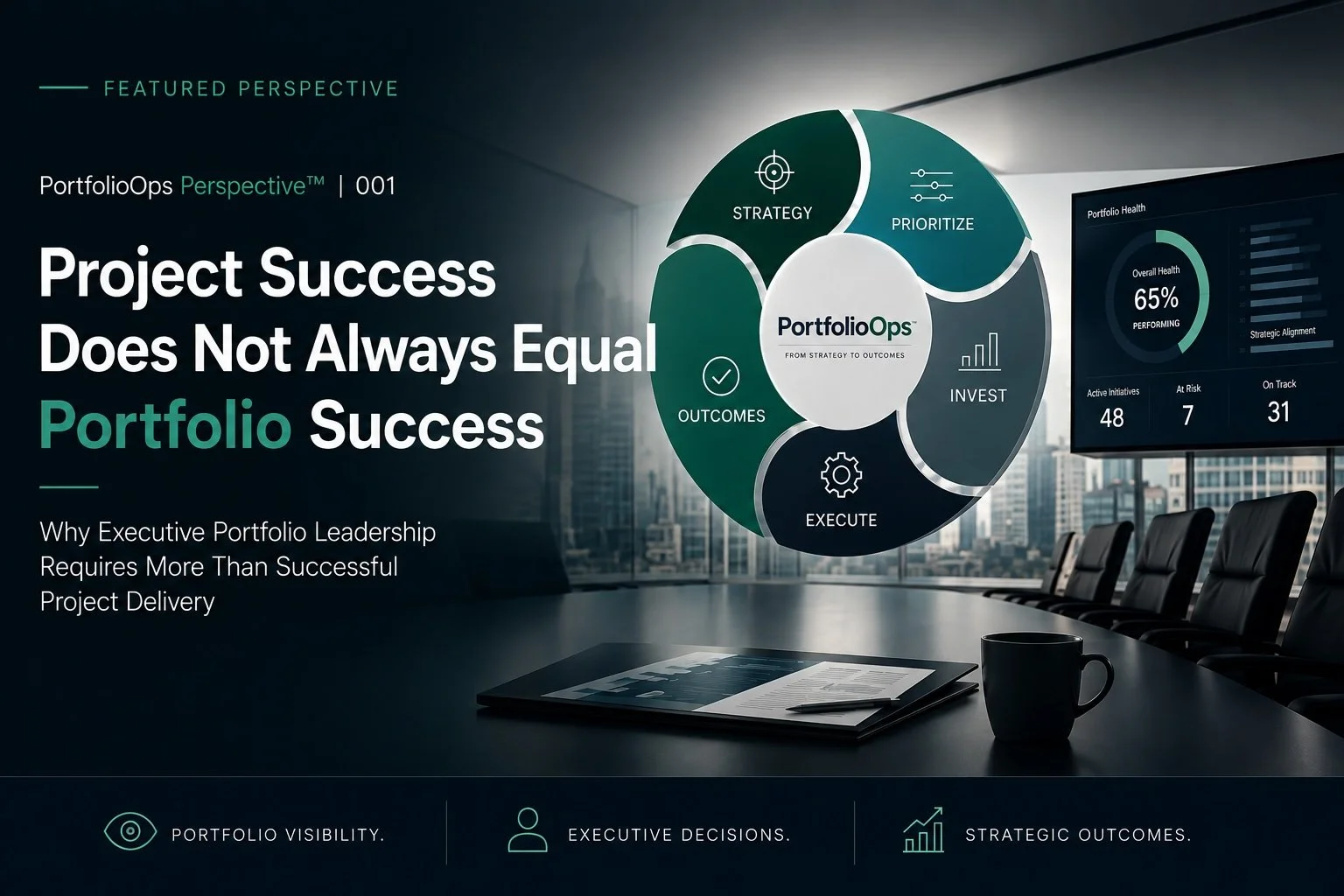
Project Success Does Not Always Equal Portfolio Success
Why Executive Portfolio Leadership Requires More Than Successful Project Delivery
By Tatia Jefferson, PMP, SAFe LPM
Founder & Principal Advisor, PortfolioOps™
The Executive Portfolio Review
The conference room is quiet.
A portfolio dashboard fills the screen.
Around the table sit the CIO, CFO, business executives, and PMO leadership. Months of planning, execution, and investment are summarized in a collection of charts, metrics, and status indicators.
The news appears encouraging.
Most projects are green.
Schedules are on track.
Budgets remain within tolerance.
The PMO has delivered exactly what it was asked to deliver.
Then the CIO leans forward and asks a single question.
"Are we investing in the right things?"
Silence.
No one questions the quality of the project reporting. The dashboards accurately describe what has happened.
But they don't answer what leadership needs to decide next.
In that moment, many organizations discover something that changes the conversation entirely.
Project success and portfolio success are not the same thing.
A Different Leadership Question
At PortfolioOps™, we believe organizations rarely struggle because they lack project information.
They struggle because executive teams lack decision-ready portfolio intelligence.
Project managers need information to deliver successfully.
Executives need insight to make better investment decisions.
That distinction influences every aspect of portfolio leadership—from governance and prioritization to executive reporting and strategic execution.
It also explains why organizations with disciplined project management can still struggle to realize their strategic objectives.
Project Success Is Necessary—but Not Sufficient
Project management remains one of the most disciplined professions in business.
Organizations depend on skilled project managers to deliver initiatives predictably and consistently.
Project success is typically measured by questions such as:
Did we deliver the agreed scope?
Did we meet schedule commitments?
Did we remain within budget?
Were project risks effectively managed?
Did stakeholders accept the deliverables?
These are essential measures of execution excellence.
Organizations cannot execute strategy without reliable project delivery.
But executives carry a broader responsibility.
They are accountable for the performance of the organization's entire investment portfolio.
A project manager may successfully deliver a customer portal.
An executive team must determine whether that investment represented the best use of enterprise resources compared with every other initiative competing for funding, talent, and leadership attention.
Those are fundamentally different responsibilities.
Executive Questions Are Different
Executive portfolio reviews rarely begin with:
"Is Project Phoenix still on schedule?"
Instead, executives ask questions like:
Are we investing in the initiatives that matter most today?
Have our strategic priorities changed?
Which initiatives deserve additional investment?
Which initiatives should we stop?
Are we allocating our talent where it creates the greatest value?
What enterprise risks require immediate leadership attention?
Are we realizing the business outcomes we expected?
Notice something important.
None of these questions can be answered by looking at a single project.
They require a portfolio perspective.
Project management focuses on execution.
Executive portfolio leadership focuses on investment decisions.
The two disciplines complement one another.
Neither replaces the other.
Reporting Is Not the Same as Visibility
One of the most important leadership transitions occurs when organizations recognize the difference between project reporting and executive portfolio visibility.
Project reporting answers questions about individual initiatives.
Project health
Schedule
Budget
Risks
Milestones
Team progress
Executive portfolio visibility answers a different set of questions.
Are investments aligned with strategy?
Where are priorities competing?
How healthy is the portfolio as a whole?
Which dependencies create enterprise risk?
Do we have sufficient organizational capacity?
Which decisions require executive attention?
Are we producing measurable business outcomes?
Project reporting tells leaders what is happening.
Executive portfolio visibility helps leaders decide what should happen next.
That distinction transforms portfolio reviews from reporting meetings into decision forums.
When Green Projects Hide Portfolio Problems
Imagine an organization managing twelve strategic initiatives.
Every project manager reports:
Green schedule.
Green budget.
Green scope.
On paper, everything appears healthy.
Then executive planning begins.
Leadership discovers that:
Three projects support priorities that are no longer strategic.
Two business units are competing for the same specialized resources.
A high-priority regulatory initiative is behind schedule because capacity was committed elsewhere.
A recent acquisition introduced duplicate investments that no one has evaluated.
Every project is healthy.
The portfolio is not.
The problem wasn't execution.
The problem was visibility.
Three Levels of Visibility
As organizations mature, leadership visibility evolves.
Project Visibility
Leaders understand the health of individual initiatives.
The question becomes:
"Is the project healthy?"
Portfolio Visibility
Leadership begins viewing initiatives collectively.
Now the question becomes:
"Is the portfolio healthy?"
Executive Decision Intelligence™
Leadership moves beyond observing work.
Now executives ask:
"What decision should we make next?"
That is the highest level of portfolio maturity.
Not simply having more information.
Having the right information organized to support confident executive decisions.
The Evolution of Portfolio Leadership
One of the most rewarding transitions in our profession is moving from project execution to enterprise leadership.
The questions evolve.
A Project Manager asks:
"Are we delivering successfully?"
A Program Manager asks:
"Are related initiatives coordinated?"
A Portfolio Leader asks:
"Are our investments balanced and aligned?"
An Executive Portfolio Leader asks:
"Are our collective investments advancing strategy and producing measurable business outcomes?"
Leadership becomes less about managing work.
It becomes more about enabling better decisions.
Decision Intelligence™
Most organizations already possess enormous amounts of project data.
Collecting more information is rarely the challenge.
Transforming that information into executive insight is.
Decision Intelligence™ connects:
Strategy
Investments
Priorities
Capacity
Delivery performance
Risks
Expected business outcomes
into a single decision-making view.
The objective is not simply to know more.
It is to decide better.
From Projects to Outcomes
Project management and executive portfolio leadership are not competing disciplines.
They are complementary capabilities.
Projects create deliverables.
Portfolios create business outcomes.
Executives create direction.
Organizations need all three.
A Final Reflection
Before your next executive portfolio review...
Look beyond the dashboard.
Ask yourself:
If every project turned green tomorrow...
Would your executive team confidently know:
whether strategy is advancing,
whether investments remain aligned,
where to shift capacity,
what to stop,
and what decision should be made next?
If not...
The challenge may not be project execution.
It may be executive portfolio leadership.
Every organization invests significant time improving project delivery—and rightly so.
The next opportunity is improving the quality of executive portfolio decisions.
Because organizations do not achieve strategy simply by delivering projects.
They achieve strategy by making better portfolio decisions.
Projects deliver work.
Portfolios deliver outcomes.
Executive decisions determine whether strategy becomes reality.
Continue Exploring PortfolioOps Perspectives™
PortfolioOps Perspectives™ is an ongoing collection of original thought leadership exploring executive portfolio leadership, governance, decision intelligence, and strategic execution.
Published
✔ PortfolioOps Perspective™ | 001
Project Success Does Not Always Equal Portfolio Success
In Development
○ PortfolioOps Perspective™ | 002 — Decision Intelligence™
○ PortfolioOps Perspective™ | 003 — Executive Portfolio Visibility™
○ PortfolioOps Perspective™ | 004 — The Portfolio Blind Spot™
○ PortfolioOps Perspective™ | 005 — The Governance Gap™
○ PortfolioOps Perspective™ | 006 — The Capacity Illusion™
Thank you for reading PortfolioOps Perspective™ | 001. Additional perspectives will be added as the PortfolioOps body of work continues to grow.