
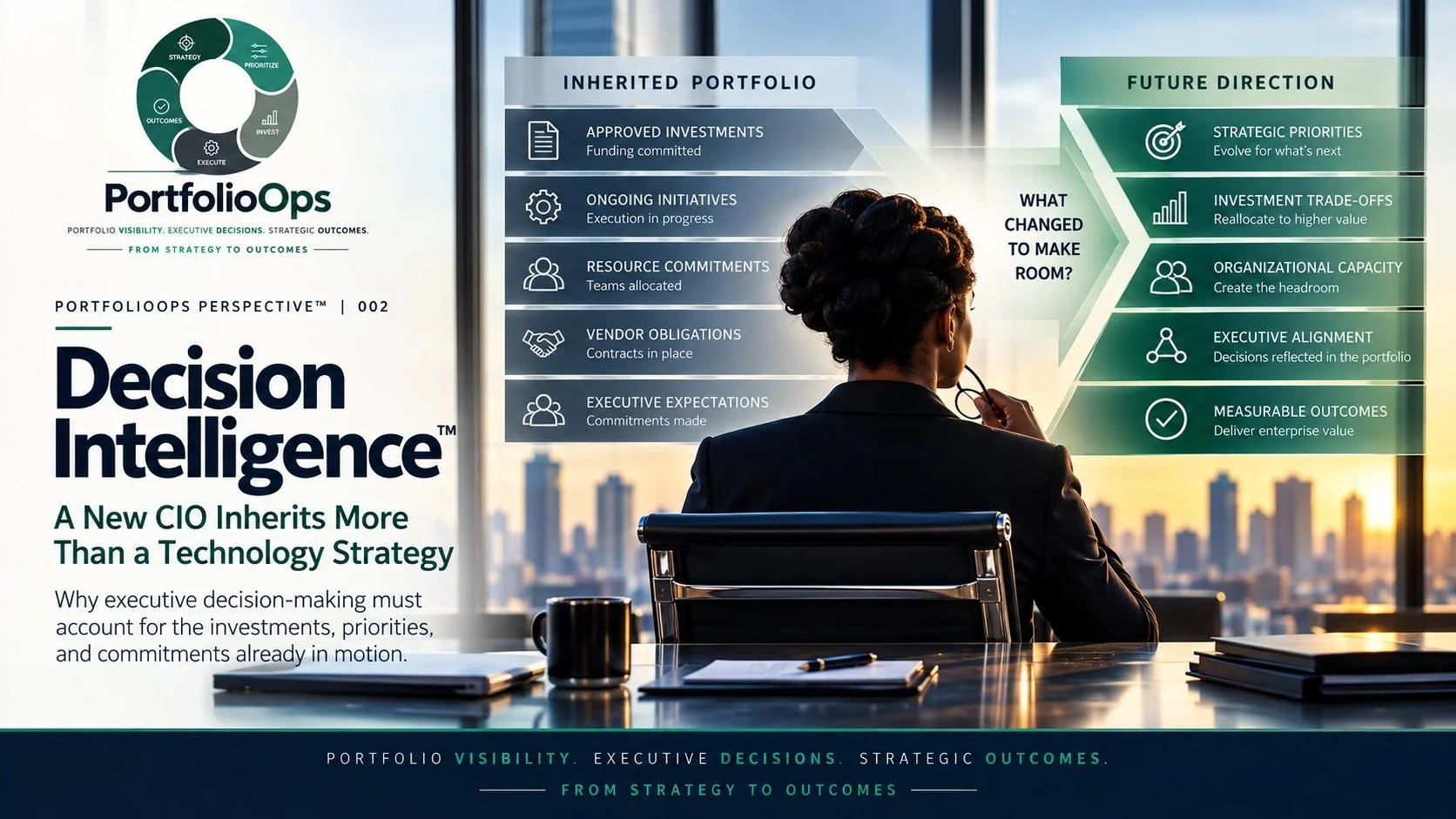
A new Chief Information Officer arrives with a mandate to modernize technology, accelerate innovation, improve performance, or strengthen alignment between technology investments and business priorities.
The expectations are often clear. The organization needs a new direction, stronger execution, and measurable results.
But the incoming executive does not inherit a blank slate.
They inherit a portfolio.
Projects are underway. Investments have been approved. Resources are committed. Technology platforms are being implemented. Business leaders have expectations, and delivery teams are working against commitments established long before the new CIO arrived.
Some of those commitments remain strategically relevant. Others may no longer reflect the organization's direction.
Yet all of them continue consuming organizational capacity.
The new CIO must understand what is already in motion while building relationships, establishing credibility, and defining a vision for the future.
And unlike the executives who approved the original investments, the incoming leader may have limited knowledge of the assumptions, negotiations, and trade-offs that shaped those decisions.
A new strategy can be announced in a single executive meeting. Changing the portfolio to support that strategy requires a different level of decision-making.
This is where Decision Intelligence™ becomes essential.
The Difference Between Information and Decision Intelligence™
Organizations generate enormous amounts of information about their strategic initiatives.
Executives receive dashboards, financial reports, project status updates, delivery forecasts, and performance indicators.
These sources may explain what is happening across individual initiatives. They do not necessarily reveal what leadership needs to decide across the enterprise portfolio.
A project can be on schedule while its strategic relevance has diminished.
An initiative can remain within budget while competing with a more important investment for limited organizational capacity.
A transformation can report favorable delivery metrics while the collective portfolio remains misaligned with changing business priorities.
For an incoming CIO, these distinctions are particularly important.
The leader may inherit a portfolio that appears healthy according to established performance measures while still lacking a clear understanding of whether those investments collectively support the organization's future direction.
Portfolio information describes activity. Decision Intelligence™ enables executives to understand the implications of their choices.
It connects the current investment environment to the decisions required to advance enterprise strategy.
That means looking beyond whether initiatives are progressing and considering whether the organization is pursuing the right combination of commitments.
A New Strategy Does Not Begin With a Blank Slate
By Tatia Jefferson, PMP, SAFe LPM
Founder & Principal Advisor, PortfolioOps™
The New CIO's Dilemma: Accountability Without Original Decision Authority
A new CIO may inherit responsibility for hundreds of millions of dollars in technology investments without having participated in the decisions that established those commitments.
The portfolio was already moving before they arrived.
Business cases were approved. Vendors were selected. Delivery timelines were established. Executive sponsors made commitments to their organizations. Teams were assembled around priorities that reflected the strategy, leadership expectations, and operating conditions of an earlier moment.
The incoming CIO is now accountable for the outcomes.
But accountability does not automatically come with a complete understanding of why those decisions were made—or whether the assumptions behind them remain valid.
This creates a unique leadership challenge.
A new CIO must establish credibility, build relationships, understand the business, and shape a forward-looking technology strategy while simultaneously overseeing investments already in motion.
Some initiatives may be essential to the organization's future. Others may be difficult to change because of contractual obligations, operational dependencies, or executive expectations. Still others may warrant reconsideration as the new leader gains a clearer understanding of enterprise priorities.
The challenge is not simply determining which projects are performing well.
It is understanding which commitments remain strategically justified—and what choices are available when they do not.
That requires visibility into more than delivery status.
It requires understanding the relationships between investments, strategic priorities, organizational capacity, and the consequences of changing direction.
A new CIO may identify an opportunity to accelerate AI adoption, modernize a critical platform, or improve enterprise technology performance.
But introducing that direction raises an equally important question:
What changed to make room?
The answer may involve reallocating investment, reconsidering timelines, adjusting organizational commitments, or engaging executive peers in decisions that extend well beyond the technology function.
These decisions can be particularly difficult for an incoming leader. Challenging an inherited commitment may mean revisiting a predecessor's decision, questioning an established business case, or asking another executive to reconsider an agreed priority.
Decision Intelligence™ enables a more productive executive conversation by shifting attention from defending historical commitments to understanding their continued strategic value.
The objective is not to revisit every decision simply because leadership has changed.
It is to ensure that the organization can distinguish between commitments worth preserving, investments that may need adjustment, and new priorities that require deliberate trade-offs.
The new CIO's responsibility is not merely to inherit the portfolio. It is to establish confidence that the portfolio can deliver the organization's next chapter.
Visibility Without Decision-Making Is Not Enough
Many organizations have invested significantly in portfolio reporting capabilities.
They can produce consolidated dashboards, track milestones, monitor financial performance, and identify initiatives that require attention.
These capabilities are valuable.
But visibility alone does not ensure effective executive decisions.
A portfolio dashboard may show that several initiatives are at risk without revealing whether the organization should continue funding all of them.
A capacity report may identify resource constraints without clarifying which strategic commitments should take precedence.
A governance meeting may review performance without resolving competing executive priorities.
For a newly appointed CIO, the challenge may be compounded by reporting structures and governance practices established under previous leadership.
The information may be available, but its relevance to the new strategic direction may not yet be clear.
The underlying issue is not necessarily the quality of the information.
It is whether that information enables leadership to make meaningful decisions about the portfolio as a whole.
The value of portfolio visibility is realized when it changes the quality of executive decisions.
Decision Intelligence™ brings the focus back to strategic relevance, investment trade-offs, organizational capacity, and the consequences of maintaining or changing commitments.
What Executives Should Consider
For an incoming CIO, understanding the inherited portfolio is as important as defining the strategy ahead. Three considerations deserve attention:
1. Strategic Relevance
Which existing investments still support the organization's direction—and which may need to be reconsidered?
2. Investment Trade-offs
What must change in funding, capacity, or commitments to accommodate emerging priorities?
3. Executive Alignment
Are leadership decisions reflected in the portfolio, or are competing commitments continuing unchanged?
Together, these considerations help shift the conversation from inherited activity to intentional investment decisions.
From Strategy to Outcomes™
A leadership transition creates an opportunity to examine not only where an organization intends to go, but whether its existing portfolio is positioned to get there.
For a new CIO, this means understanding the investments already underway, the decisions that shaped them, and the commitments that may need to evolve as strategic direction becomes clearer.
For the broader executive team, it means recognizing that a change in leadership or strategy does not automatically change the portfolio.
Decision Intelligence™ helps bring those realities into focus.
It is not about producing more information. It is about enabling executives to understand the implications of their choices and make informed decisions about the investments entrusted to them.
The decision is not complete until the portfolio reflects it.
PortfolioOps™ | From Strategy to Outcomes™
Ready to understand what your portfolio is telling you?